

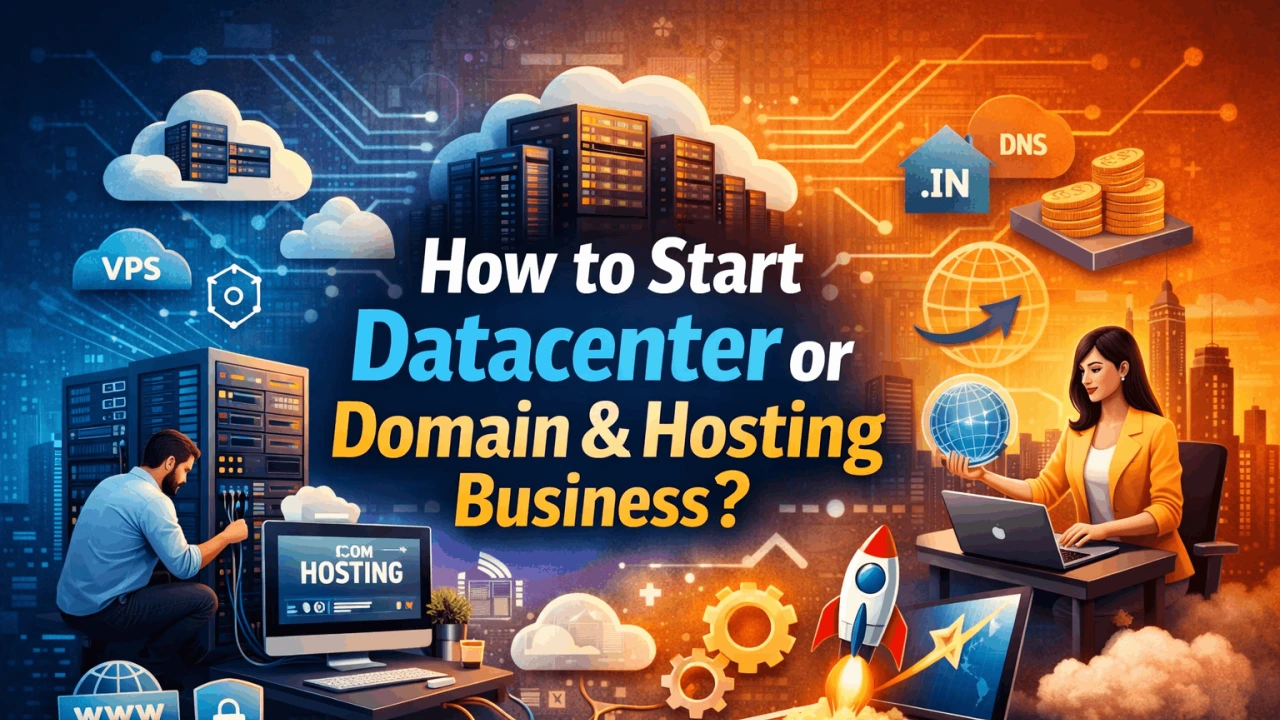
How to start Datacenter or Domain and hosting business
Domain:- the domain is unique name which have to registered by registrar as ICANN. The domain support many extensions like .com, in, .ae, .co.in, .ai, .site, .xyz. for every country there is reserved extension for in for india, .us for usa, .cn for china and many more.
Web hosting:- host the any type of data like website, images, video is known as hosting.
There are many hosting provider as mrcloudhosting, hostingraja, godaddy, hostgator, namecheap, tmdhosting, utho, etc. In marketing there many categories available for hosting as web hosting, wordpress hosting, nodejs hosting, cloud hosting, vps hosting, video hosting, etc. the hosting company make categories in their own way to define the structure of hosting with pricings. The cheap of less price hosting has many limitations some of them it is mentioned and while some not as file and directory limits as inodes. Bandwidths, ffmpeg, email limits, etc
Web hosting:- many companies has this plans in which they categorised based on pricing as gold silver bronze, basic standard enterprise, etc. to purchase web hosting you have to visit the provider website and select the plan as per requirements to host, you have add2cart, checkout with details by making payment you can use the hosting panel with purchased features.
Wordpress hosting:- if you need to host any wordpress website then you choose this plan.The wordpress is less time take to develop the website which helps to make business presence for small organizations. You can also host your local wordpress website to live. Then wordpress website has limitation in terms of scalability. For big companies they prefer coding website so they can make use to handle such large traffic, data sharding, docker, etc.
VPS hosting:- for full access or control of server you can choose vps hosting also known as virtual private server. It has dedicated ip and you can install any operating system as mentioned in the available list like ubuntu, cloudlinux, almalinux, etc. if you need graphical user interface like management of panel as cpanel, aapanel, etc then you have to pay extra for license. If you don’t want extra pricing and you have experienced in cli for linux based you can save money by opting this. You can also see the resource usage of your server by installing package in your website to get realtime analytics. In this hosting you have full control and also you can directly run cron jobs, queue jobs and can setup freepbx as siptrunk, etc
To start this business you need to purchase a domain and you have to purchase the vps hosting you can setup the whmcs for panel management to use the features like emails, remote database, mysql using phpMyAdmin, pgadmin, shh or terminal, jobs, billing information, myql wizard, ftp creation, redirection, git for version control, ssl installation as lets encrypt, etc. To make this installation you have to visit whmcs installation website to begin the installation you have to make cmd as mentioned in the website and follow the instructions. When installed then you have to open the ip in the browser and mention the license key if you have purchased and want regular updates and support from panel company. After that you can configured with yours website so users can purchase the hosting with the desired plan as per their personal or business requirements. For domain booking you can purchase the reseller api as from bv and many other providers are available.
To open the datacenter for your business you will have to invest large amounts of money and we are sharing some basic information or requirements for this:-
Space:- you need to take land on rent if you have owned then it is a plus point.
Lease line:- you have to buy a lease line service with your nearest isp to support non-stop internet service.
Power Backup:- to run all devices the organization need to maintain power backup to restart the services like generator.
Racks:- to maintain the devices you will need racks to setup properly in that.
Server:- as per requirements you will need server with custom ram , storage, cache memory, workers, cpu generation, etc there are many providers for servers in the market are as dell, Lenovo, penguin, intel, etc
Switches:- to connect one server with our server you will need switches to establish the network between two or more servers.
Router:- to make your server live you will need router such as cisco, juniper, etc
Firewall:- If you need an extra security then you have purchase the firewall as cisco, paloalto, Fortinet etc
IP:- you need to host your server to live then you need to buy the public ip form your nearest isp. That ip and ports you have to configured in the router.
Custom panel:- you can also make yours own custom panel like aapanel, cpanel, etc for the management of servers. For this you will need developers who are available to add the new features and provides customers support to the clients.
Engineers:- for this the organization needs networking engineers to maintain the healthy ecosystem, should have troubleshooting skills for every devices. In everyday the new issue will be arises for that you have ability to solve the any issue.
Security:- for security you can install immunify 360 for maintaining files security by detecting malware.
Business expansion:- for business expansion you need sales and marketing teams who will lead and make the sales to grow the business and fulfil the requirements of the clients by providing affordable pricing.
Top companies for Datacenter
Rankbank
Serverwala
Equinix
LiveMNC
Nxtra

Futuristic Smart with BYD Electric Vehicles
There's competitors now ramping up and as you're familiar with BYD which is also on the west coast I think they're ramping up production of their electric vehicles. Warren Buffett owns 10% stake in that. Why do you laugh? Trying to compete why do you laugh? Have you seen that car? You know BYD was once a joke, a complete laughing stock in the industry.
This plain looking sedan is actually one of them. It's from Chinese automaker BYD. Bad looking car, it further looks like a Corolla or maybe a Kia Optima. Vehicles that are ready, that are up to snuff in terms of quality, fit and finish, design, that remains to be seen yet. You don't see them at all as a competitor? No.
I don't think they have a great product. In fact, if you look closely, while Tesla had Elon Musk, the visionary, charismatic billionaire founder, BYD was led by a humble man, a former government employee with no degree in automobile and no background in technology or design. In fact, he had never built a tech product in his life.
And look at this, in 2021, while Tesla sold 930,000 cars, making $53 billion in revenue, BYD barely sold 590,000 cars, making only $32.75 billion. So $32 billion is a lot, but it was nothing as compared to Tesla and the reputation of Tesla. But you know what's crazy? Warren Buffett saw something different in BYD.
He believed that BYD could make better cars than Tesla. BYD is a young and promising company experiencing dynamic growth. A leader in innovation and technology. Our joint strength is based on high-tech cooperation and BYD has a bright future. And as always, the wise old man was right. Because in 2024, while Tesla made $97 billion, BYD stood tall at $108 billion and BYD told the world loud and clear that there's a new gangster in town.
It likes to describe itself as the biggest car brand you've never heard of. you've never heard of. Now China's BYD has overtaken Tesla as the world's largest seller of electric vehicles. Now it's beating Tesla with EVs only. Let us help you build your dreams. BYD. And this is a classic David versus Goliath story.
BYD And this is a classic David vs Goliath story. So the question is, how did a government researcher outsmart the world's most celebrated innovator? How did a company that was once mocked become the new king of EVs in the world? What secret formula transformed BYD into Tesla's worst nightmare? And most importantly, what are the business lessons that we need to learn from the iconic rise of BYD? This context is brought to you by the magical Odoo manufacturing app.
People, if you're in the manufacturing business, you know how crucial it is to streamline operations and maintain top-notch quality. And Odoo's manufacturing app is a magical tool that can simplify and streamline your entire process to make it faster, easier and more efficient. Firstly, Odoo's manufacturing app triggers automatic quality checks and also provides you with the shop floor where each operator can sign in and see exactly what they need to do.
This helps you manage who's doing what, keeps the work hierarchy clear and allows you to run multiple assembly lines smoothly. By leveraging work centers and automated assembly lines, Odoo enables you to optimize and manage manufacturing orders effortlessly. This improves accuracy, productivity, and overall workflow efficiency.
Odoo also has barcode integration, which helps you speed up operations, track products easily, and manage everything in real-time. The planning and scheduling feature helps you organize work orders, track materials, and plan production efficiently. All of this happens through Gantt view. This view shows you all the assembly timelines and operation dependencies.
Plus, the bills of materials overview provides a clear picture of cost, time and component availability even before production begins. Odo manufacturing also provides in-depth reporting such as production analysis, production efficiency, work orders etc.
And the best part is they provide lifetime free access for your first Odoo application. So if you're running a manufacturing business and you're serious about scaling with precision, efficiency and clarity, check out Odoo manufacturing app using the link in the description. This is a story that dates back to 1995. At that time, the global battery market was a game only meant for kings to play.
If you wanted to enter the market, enter this business, you at least needed $1.7 million. And the industry was ruled by giants, Japanese powerhouses like Sony and Sanyu. Now, most people would have said, Arrey bhai, this is a game for rich people. How can we middle class folks enter this game? Let's do something small and safe and be happy and earn bread for the family.
But you know what Wang did? Wang made an observation. He noticed that the battery market was shifting very very drastically from nickel-cadmium batteries to lithium-ion batteries. And this shift was happening for three major reasons. Firstly, lithium-ion batteries could store more energy. So while a lithium-ion battery could store up to 260 Wh per kg, while nickel-cadmium batteries are limited to around 50 Wh per kg.
This means for every kilogram of battery mass, a lithium-ion battery stores at least five times more energy. That is why devices like smartphone started to use lithium-ion batteries so that they could be lightweight and yet super powerful. Secondly, nickel-cadmium batteries lose capacity over time if you recharge them before they are fully emptied.
But lithium ion batteries, they could be charged anytime with no damage at all. And thirdly, cadmium, which is found in the nickel cadmium batteries, it is a toxic heavy metal which pollutes soil, water and harms workers. Whereas if you look at lithium ion, it is cleaner and far safer for the planet.
Now you tell me guys, if you were to pour all the money that you have, where would you invest your money? Obviously in lithium-ion, right? After all, it was clearly the future. But you know what Wang did? He did the complete opposite. He invested all his money into building a nickel-cadmium factory. So the question is, why would he do that? Well, that was because while Sony and Samio moved to lithium ion batteries, large companies like IBM still needed nickel cadmium batteries. So Wang saw a hidden opportunity.
He thought that he could actually serve clients that the large companies were ignoring. So he took a big loan from his cousin and invested all that money into building a factory to make nickel-cadmium batteries. But here's the twist. While Japanese factories used cutting-edge tech, Wang actually went the complete opposite way.
He said bro, Japanese have technology but China has cheap labor. In fact, if you look at the stat in 1995, labor cost in Japan, the monthly minimum wage was about $189.28. While in China, it was only $24.38. So instead of expensive machines, Wang built simple systems that used workers' hands, but it was actually made by people with machines and not robots.
And this ultra-frugal method became BYD's first superpower. And amongst all the frugal engineering strategies that Wang applied, I found one story that will blow your mind. In fact, it changed the destiny of BYD. You see, to make nickel cadmium batteries, you needed absolutely dust proof rooms because cadmium is a highly toxic and reactive heavy metal.
So even a tiny particle of dust, moisture or oil can contaminate the electrodes, it could cause poor performance and it could even defect the material. In fact, in some cases, it could even cause the battery to catch fire. In fact, workers must also wear full body suits with masks, gloves and hair covers so that even tiny skin flakes or breath moisture doesn't contact the battery.
So to protect both the product and the workers, the manufacturing usually happened in super clean dust proof rooms, also called clean rooms. On top of that, while normal air has around 35 million dust particles per cubic meter, a nickel-cadmium battery clean room might just allow 3520 particles per cubic meter.
That's over 99.99% cleaner air than usual. But you know what Wang did? He asked himself, Baba, if you don't want your legs to get dirty while walking, will you lay a carpet all around the world or simply choose to wear shoes? Obviously wear shoes, right? Then he thought, why do we keep the entire factory clean when only the battery cell needs a clean environment? So instead of building a huge clean room around the workers, he built a small transparent clean box.
And here's where workers could put their hands inside and make the battery. So each worker had a sealed glove box like a mini clean room. And workers could insert their hands through the gloves assemble the battery parts and keep it within the enclosed box itself. This way, they could keep the dust out of the battery completely.
At the same time, they did need clean rooms. In fact, the air inside was filtered and pressurized as per the clean room requirements. This is the reason why they could have a general room where the battery was being manufactured. And this gave Wang three incredible superpowers. Firstly, only the actual battery cell assembly zone needed protection, not the whole building.
This saved them millions of dollars. So only the box was manufactured in a small clean room, but the manufacturing facility didn't need any high-tech cleaning. Secondly, the cost of making the battery due to this box and several other strategies helped him reduce cost by 70-80%. That's about 5-6 times lesser than the competition.
And lastly, if Sony needed to scale their production, they needed to build another clean room with hundreds of crores in investment. But if BYD wanted to scale, they just needed to add more boxes and workers. That's it. In fact, Wang even decided to skip over high-tech machines and build simple machines like the glove box because the Chinese labor was cheaper than the machine.
Like I said, in 1995, the monthly minimum wage was about $189.28 while in China, it was only $24.38 This is how through ultra low cost production easily scalable model and a huge cost benefit in the market BYD started scaling This is how BYD won giant clients like Nokia and Motorola and by 2002 BYD had a 31% market share That is how they made their money Now if you were a government employee turned entrepreneur who's making millions of dollars selling batteries, you would be happy, right? Well, Wang wasn't.
While most people saw this business as a rock solid million dollar company, Wang realized that he actually built a castle of sand that won't sustain long. Because he knew that he was making nickel cadmium batteries and the world was soon going to move to lithium-ion batteries. So you know what Wang did? He said, we will build a car.
And they did build a car. But the problem was that it was a terrible car. And you know what, guys? They built these kinds of cars for 10 long years. And during the same time, Tesla rolled out great products, revolutionized the entire American EV market and came to China and became a billion dollar company.
But BYD? Well, they were a joke for the press. Some journalists joked about how the front of the BYD car looked like a Toyota Corolla and the back looked like a Chevrolet Optra. Others were filming the doors of the cars not shutting correctly. So long story short, BYD had no edge in technology, no edge in design and they had nothing special.
Their low-end models got old and their newer models failed to take off. Even their early electric buses in the US faced reports of poor performance, mechanical problems and terrible driving ranges. And just when things couldn't get any worse, the pandemic hit in 2020. Now when the pandemic hit, supply chains halted, people stopped buying cars and BYD had over 224,000 employees that they couldn't afford to pay if sales didn't come.
And look at this, Ford, Tata Motors, Jaguar Land Rover, Nissan, all of them were in losses. But I was surprised to know that BYD in 2020 still made $643 million in profits. The question is, how the hell is that even possible? Well, you know what guys, I read something on cockroach entrepreneurs. It says that when everyone else is running for cover, the cockroach entrepreneur finds a crack and keeps moving.
That's exactly what Wang did. He became a cockroach. During COVID, when cars couldn't be sold, Wang saw that they could easily manufacture masks and sell hand disinfectants. So he quickly repurposed their factories and became the world's largest mask producer of face masks. Not cars, but face masks. On January 31st, Wang Qianfu, President and Chairman of BYD, decided that the company must begin making masks within two weeks.
These masks have been shipped to hospitals, law enforcement agencies, local governments and many more. That is how they made 643 million dollars in profits even in 2020. This is how Wang survived the COVID wave while the world was making fun of BYD. But this still begs the question, how did they beat Tesla? Tesla was miles ahead of BYD, right? Well, as it turns out, Wang understood that to succeed in the EV market, he just needed to master three things.
Cost, R&D and design. For example, Tesla had dramatically cut its cost per vehicle. Look at this. In 2017, it cost about $84,000 to build a Tesla. But in 2022, data showed that Tesla's input cost averaged just $36,000 per vehicle. That was about $10,000 less than the other average EV vehicles. And lastly, Wang realized that BYD cars needed to look better than Tesla and they could no longer be a cheap copy of American cars.
So after pouring all the profits from the battery unit into research and development, in 2020 BYD shocked Tesla with something called Blade Battery. For those who don't know, in 2020, Tesla Model 3 used NMC batteries or Nickel Manganese Cobalt batteries. And if you remember, these batteries had a big, big problem.
Tesla is investigating this fiery explosion in Shanghai. It appears to show a Model S bursting into flames in a parking lot. The fire spread to the home and burned it down. Fire spread to the home and burned it down. As you saw, if the cars with NMC batteries were severely damaged or exposed to extreme heat, they could catch fire or even explode.
In fact, normal lithium-ion batteries burst into flames at over 500 degrees Celsius. But BYD's Blade battery uses lithium-ion phosphate chemistry and it passed a brutal test called the Nail Penetration Test. As you can see, engineers literally drove a nail through the battery until it penetrates completely causing a short circuit inside.
And the other batteries caught fire at over 500 degrees Celsius. But surprisingly, BYD Blade gave out no smoke and no fire. In fact, it would barely touch temperatures of 30 to 60 degrees Celsius. Do you realize what that means? While a passenger in normal EV cars would burn to death in case of high impact accidents, with blade battery, the car wouldn't catch fire at all.
In fact, BYD batteries became so good that in 2024, Tesla started to buy batteries from BYD. Tesla has admitted that BYD batteries are superior and will use them to power Tesla vehicles. The Chinese company is about to start supplying Tesla with its own battery cells. BYD's unit, Fendream, secured over 20% of orders in March and supplies will begin in the first quarter of next year.
Secondly, BYD did an excellent job with cost-cutting. Look at this. While BYD SEAL cost $15,270 in China, Tesla Model 3, the counterpart of BYD SEAL, cost $36,278.99 in China. And even in the US, while BYD SEAL cost $46,990 with trade tariffs, Tesla without tariffs still cost $36,990. $36,990. Secondly, while Tesla's prices start from $36,270 per vehicle in China, BYD starts at $7,800 in China.
So the question we hear is how did BYD achieve this? Well, firstly, since BYD was a Chinese company made in China, sold in China and had local battery production unit, BYD enjoyed an approximate $2,000 to $4,000 subsidy per car. Secondly, BYD enjoyed an approximate $2000-$4000 subsidy per car. Secondly, BYD achieved full vertical integration where they do everything from mining to manufacturing to design to battery manufacturing to even recycling in-house.
This saved them another 15% in cost as compared to Tesla Model 3 and 30% lower than the western companies. Thirdly, if you think about pure electric vehicles, you will see that people are usually concerned about two things, price and range. But you know what BYD did? BYD, instead of making EVs, they made PHEVs.
For those who don't know, BEV means a fully electric vehicle that needs a battery to run. And PHEV is a hybrid vehicle where if your EV charging runs out, you can use your gas engine until the next charge. And by the way, PHEV stands for Plug-in Hybrid Electric Vehicle. And this is where the magic happened.
You see, manufacturing a hybrid vehicle over a fully EV car had three major advantages. Firstly, the battery is usually the biggest cost driver and costs about 40% of the total cost of manufacturing. But in PHEV cars, you needed a smaller battery. So they cost around 20 to 30% less. Secondly, BYD could eliminate range anxiety in the Chinese because with hybrid, you can give people the cost advantage of an EV but the dependability advantage of an IC engine car.
So in tier 2, tier 3 China, where people don't find charging station, they were fine using a hybrid BYD car, but they couldn't use a Tesla. Thirdly, if you look at the Chinese population, China has four major categories. China one has 23 million people who make more than $18,000 per portion per year. China two has 242 million people who make between $7,300 to $18,000 per portion per year china 2 has 242 million people who make between 7 300 to 18 000 dollars per portion per year china 3 has 493 million people who make 3650 dollars to 7 300
per portion per year and china 4 the poorest population of 645 million people make around 3650 dollars or less per year now while tesla could only sell to 23 million people make around $3650 or less per year. Now while Tesla could only sell to 23 million people in China 1 and barely sell its Model 3 base model to China 2, BYD could sell its cars to China 1, China 2 and it could also sell its base models to China 3.
BYD could practically sell to 758 million Chinese people and in tier 2, tier 3 cities with no charging infrastructure. Whereas Tesla, they could barely sell to 265 million Chinese people. Which is why if you look at this chart, out of the top 6 selling BEVs and PHEVs, 5 of them are BYD and just one is Tesla.
And more importantly, the sale of the top 2 PHEVs is more than the sale of the top 3 EVs combined. This is how Wang sold for cost and accessibility using R&D and product portfolio. And if you look at BYD designs today, they look like this. This is how, by first building a cash corp for himself, then by investing that cash into R&D while the world laughed at him, then by consistently working on the attributes that he was mocked for and most importantly, by solving for the Chinese people better than his American counterparts, Wang ended up building one of the greatest companies in Chinese history.
And he literally went from being a laughing stock to a multi-bagger stock in the last 20 years. This is the crazy story of PYD and it has three very very important business lessons for all of us. Lesson number one, before you start chasing glory, always build a cash cow. Before dreaming of cars and global fame, Wang first mastered the unglamorous business of batteries.
That's where he got the money to build a castle of glory because no glory comes without cash flow. Lesson number two, innovation isn't always about sophistication. Sometimes it's just about simplification. And the smartest solution is often the cheapest one that just works. And the clean box that just works.
And the clean box that Wang built is a classic depiction of this lesson. And lastly, always remember when people throw bricks at you, you've got two choices. You can either run and blame the world for being unfair or you can pick up every single brick, dust it off and start building your castle. That's exactly how Wang built his company called Build Your Dreams.
And for more such insightful business and political case studies stay tuned to Bindaas Bol Dil Se.

Want to start an ecommerce business in India?
What is Ecommerce?
Ecommerce is known as internet commerce which products or goods will sell or purchase through online medium in which sellers can sell and buyers can buy their needs. Ecommerce plays a major role in boosting economy valued around $125-$148 billion in 2024, with projections to hit $340-$380 billion by 2030. Due to huge demands of online products or services major companies goes online to scale their business. It helps to generate major revenue and it is opened 24*7 users can anytime book their orders for products or services.
Features of Ecommerce:-
Variety of Products:- in any platform for ecommerce it has many variety of goods with many ranges and they can compares to find best with their needs.
Emi facility:- In shopping platforms they are now providing shopping with emi facilities with their banking and fintech partners. So it increases sales of businesses with flexible rate on interest on emi with autopay features which can deduct from their bank accounts.
Wide ranges:- products has wides ranges based on classification from low to high, colors ranges as white, black, blue, green, yellow, etc with brands selection as many listed brands as nike, puma, adidas.
Wide Categories:- now platsform provides wide ranges of multiple categories as fashions for mens, womens, childs, etc , shoes with various brands with multiple types, electronics and accessories as laptops, spare parts as cpu, ram, hardisk, etc.
Returns:- these platforms provides return features in which users can returns the products if they are not satisfied with quality, size, color, defective as expected you can return easily.
Refunds:- whenever your order products get returned it will get refunded within defined duration in amazon 5-7 days in some case.
How to Start business Online?
When yours platform is growing and stable then you con thought about other business that is the process how enterprise works as Adani Groups, Reliance Groups, Zoho Corp, etc. you have to be success in one domain then you have to go in another domain. Never do multiple businesses in first one is not stable it will lacks in failures as Anil Ambani done due to opening of its multiple businesses in meantime. Every businesses should follow pipelines to grow their business with their teams. Teams is major core part of yours business which helps to scale with their expertise, feedbacks, leading in a way the usp matters. When company grow you should focus on culture that really matters how you treat them. If you understand yours employee problems and customers issue you will definitely build the business.
Is boAt Losing Market Value?
In the year 2020, BOAT had become the fifth largest wearable brand in the world. It had beaten all the Indian brands and was in the leagues of Apple, Xiaomi and Samsung. Then, between FY20 and FY23, BOAT's revenue increased from Rs 700 crore to Rs 3400 crore. And that's a 5x growth in just 3 years. BOT's smartwatches and their earphones were everywhere.
And Aman Gupta was one of the most celebrated entrepreneurs in India and his company was getting ready for a blockbuster IPO. But then things started to change. BOT's revenue started to fall. It started losing to other players in the segment.
In fact, things got so bad that both its co-founders Aman and Sameer quit their positions and moved to known executive roles. So what exactly went wrong with BOAT? And what does the future look like for the company? Welcome to our weekly Indian startup news show. I'm Pankaj, your host, and you're watching Backstage with Millionaires. So, let me take you back to where this story really starts, which is not 2014 when BOAT was founded, but in 2020, when Bat really took off.
See, when the pandemic hit, Boat was already an established and growing brand, but COVID helped them accelerate at an unprecedented pace. The screen time for people grew multifold. Also, almost everyone was working from home. And because of that, people needed headphones. In fact, demand for audio products grew 20% in the early months of pandemic alone and Bode, which had spent years building the most recognizable and affordable audio brand in India, benefited from it the most.
But that wasn't the only wave Bode caught in 2020. As people started tracking their health obsessively during the pandemic, smartwatches suddenly became a mass market product. And Bode saw this as an opportunity and launched their own smartwatch line in October 2020.
And this wearable segment of theirs, which did not exist until 2020, went on to bring 900 crore rupees in revenue within the next two years, which was nearly a quarter of everything the company made. And thanks to these two waves and Aman Gupta being on Shark Tank, Bote had crossed 3376 crore in revenue in FY23. But then things started to change. The two waves that Boat was riding suddenly started to disappear.
And let's first talk about their smartwatch business. See, once the hype of smartwatches started to fade after the pandemic, people started evaluating their smartwatches more critically. And what they found was that these entry-level smartwatches, the kind that BOTE made, which were typically priced below Rs 2,500, did not really have the most accurate health tracking.
Basically, the consumer expectations from these products had gone up, but these products failed to keep up with the consumer. And as a result of this, the smartwatch market started shrinking in India. In FI24 alone, it collapsed by 34% and Bote was the most impacted company. Bote's smartwatch segment that brought in 901 crore rupees in revenue in FI24 had gone down to just 330 crore rupees in FI25, a 63% decline in just one year.
But the thing to understand here is that consumers were not necessarily ditching smartwatches entirely, they were just ditching the low-quality ones. And I'm saying that because the market for premium smartwatches had essentially doubled during this time. The kind of smartwatches which are priced over 20,000 rupees. A segment where players like Apple and Samsung exist.
So, smartwatches was the first bad news for Bode. Next came its audio business. The segment that had essentially made BOAT also started declining. And I think this is a more deeper and existential problem for BOAT. See, when BOAT had built their reputation, they had a genuine edge. They were selling affordable products with cool designs.
But that edge is now gone. It worked for BOAT when they were the only player. But today, they have a tough competition from a bunch of new age Indian brands like BOAT Audio and Noise, along with international brands like Realme, Nothing and OnePlus. Basically, this category is being commoditized right now.
And when a category commoditizes, the brand that's perceived as affordable is usually the one that gets hurt most. And the culmination of all this happened when the two people who built Bolt, Sameer Mehta and Aman Gupta, decided to quit and transition to a non- executive role. And now the company has brought in a new CEO. In fact, Boat has changed three CEOs in the last three years. And that's not good for a brand that's already losing its market.
So is this the end for Boat? Or do they have a plan? Well, sort of. According to the DRHP, Boat now wants to focus on the premium segment, products above 5000 rupee range. And the company now wants to focus on building better technology instead products above 5000 rupee range.
And the company now wants to focus on building better technology, instead of just playing on the price. And that is the right direction. The premium audio market is where the growth is. But the problem with this segment is that it is owned by Apple, Sony, Samsung, and JBL. And competing with these brands won't be easy. All of them have spent decades building credibility for premium audio.
And BOAT has never competed at that level. And now repositioning a brand that builds its reputation on affordable and trendy to suddenly play in premium is one of the hardest things to do in consumer electronics. And before I wrap it up, let's quickly talk about their IPO. See, when they were at their peak.
And at that time, they were planning on raising 2000 crore rupees. But the company decided to postpone it because of bad market condition. Then they again filed for an IPO in 2025. This time with the plans of raising 1500 crore rupees. But again, these plans were postponed. And we don't know when the company will finally go public.
Also, there are some concerns with their DRHP as well. Boats own auditors have flagged that Boats quarterly returns filed with the banks did not match the company's internal books. And that too for three consecutive years. And that raises a lot of concerns. See, trying to go public with three years of bank versus book mismatches is not the best story to tell to the public market investors.
And that at a time when your revenue is also falling. So right now, Boat might have a plan, but they don't seem to have the right people to execute that plan let me know what you guys think do you think both will be able to make that transition or will it just suffer the same fate as someone like lava or micromax all right next up urban company has just announced that their quick housekeeping vertical insta health has crossed 1 million monthly bookings in march and that's a big number especially considering the fact that they had launched this business vertical
just one year back. And now the company is calling it their fastest scaling business unit in their history. And since they announced these numbers, their share price has climbed over 10%. Now, if you look at the service, it's pretty straightforward. They have on-demand cleaning, dishwashing, laundry, and meal prep, all fulfilled in 10 to 15 minutes from booking.
And the service right now is only live in cities like Mumbai, Bengaluru, Delhi NCR, Hyderabad, and Pune. But here is where it gets interesting. This space is starting to look a lot like what happened with QuickCommerce a few years back, where you had new players coming up every day. Also, investors putting in millions of dollars to help these companies scale fast, and the media still questioning if this is even a profitable model.
Now, coming to this house help market, Urban Company's Instahelp currently leads this market with 49% market share, while Snabbit is next with 36% market and Pronto is at number 3 with 14% market share. But the thing to note here is that startups like Urban Company are burning money right now to acquire this market. In quarter 3 of FI26, Arvan company registered an EBITDA loss of 61 crore rupees. And same is with Snabbit and Pronto.
So the growth and all is good. But the real question is still the same as it was in the quick commerce. Will anyone be able to make this profitable at scale? Alright, moving on to some quick news updates. B2B manufacturing platform Zetwork has confidentially filed for their IPO papers and they are looking to raise around Rs 4,200 crore or almost $450 million.
The company was founded in 2018 and they basically help connect businesses with contract manufacturers across sectors like electronics, aerospace and industrials. The company posted operating revenue of Rs 12,798 crore in FY25 with a net loss of Rs 371 crores. Talking about IPOs, furniture and electronic appliance rental platform Rentomojo has filed for DRHP with SEBI to raise Rs 150 crore in their IPO.
But one of the co-founders, Ajay Nain, has filed a petition with NCLT claiming that he was misled into selling his 9.41% stake to an employee benefit trust back in 2023. And now, Ajay wants to void that share sale, restore his shareholding, and stop the company from its planned IPO. Alright, next up, Mirza International's MD Tauseef Mirza has acquired a 100% stake in D2C casual footwear startup called Solthreads.
And this company is already clocking a monthly run rate of 6 crore rupees and this deal will help mirza international to expand into india's youth focus semi-premium footwear market all right now let's move into the funding news segment for today's video this week indian startups raised a total of 47 million dollars which is significantly lower than last week's 268 million and now let's take a look at some of the startups that have raised funds this week. The first one I want to talk about is Batchat, which is a simple app that helps you
save small amounts of money every day automatically instead of big monthly investments. Basically, what they do is they take tiny amounts like 50 to 100 rupees via UPI and invest them in mutual funds. So even people with irregular income can build savings easily and they've raised 12 million dollars in their series A round.
Following that, we have Mumbai-based Amaha, which is an online mental health platform where you can talk to therapists, get medical help, and use self-care tools all in one place. And they've raised 50 crore rupees or $5.35 million. After that, we have the D2C nutrition brand Beast Life that sells things like protein powder and supplements. And they've raised 20 crore rupees or $2.
million in their pre-series a round next we have cyber security startup called sign3 which is an ai powered fraud prevention platform and they help banks fintechs and online businesses to spot and stop scammers by analyzing device data and user behavior like typing patterns or mouse movements and they've raised 1.
million dollars and finally we have epic an online e-commerce platform that lets you try gadgets at home before you buy them what they do is they basically send someone to your house with the product so you can test it in real life and decide whether you wanna buy it it's basically an online shopping with a real world trial experience and they've raised one million dollars in their pre-seed All right, that's all the startup news I have for you this week. Thank you so much for watching and I'll see you in the next one.
Trends that Transforms Nation:- Exclusive news coverage 24*7 With Bindass Bol Dil Se. Follow us and get updated in runtime with our networks.